Thursday, May 29, 2014

Informing the Stereotypes - Kelly Kapoor and The Office

by Mitchell Isidro

Picking up from where I left off with my “Are You Even Indian?” post, I covered the unique way Kelly freely defines herself to be Indian American and how that reflects the poly-cultural attitude of the younger generation of Asian Americans. I also wanted to make it clear that within the context of comedy shows her portrayal is primarily to humor the audience and should not be seen as offensive. Subsequently, the writers of The Office continue to play off of stereotypes even unto the series’s fifth season. I argue that even as the writers make fun of her “Indianness” with small references to Asian female stereotypes, Kelly's portrayal is largely for comedic reasons which help inform audience members of such racial categorizations.


        It is important to discern what specifically are those, albeit indefinite, stereotypical portrayals of Kelly in The Office such as her depiction as a submissive Asian female. In season 5’s Customer Survey, one of Michael’s opening lines is praising Kelly as the office’s  “dusky and exotic customer service rep” which reflects an inaccurate view  of the “mysterious” Asian American woman shared by some members of American culture. Building off of such a view, Kelly is later found guilty for seeking revenge on Jim and Dwight. However, when she is accused by Michael, she randomly claims that she has been raped to rapidly change the subject in a humorous way despite being a very serious subject. Thus it produces two contradictory portrayals of her character both as a vague reference to a devilish and secretive side of the "mysterious" Kelly with her revenge plot, and as a victimized “china doll.” Again, it is important that I caution that these situations are meant for comedy and therefore should not be appropriated as examples to be critical of the show. I believe that the writers put these small references to Asian female stereotypes in the show to create some sort of awareness about such stereotypes. Even in the next episode “Business Trip” Kelly magically hooks back up with Ryan again after Ryan impresses her with his push ups and then subsequently shares a ridiculously passionate kiss in spite of already being in a relationship with Darryl. This may point to, again, the docile china doll stereotype that is easily manipulated that Kelly finds herself portraying occasionally. Yet, in context this should not be surprising because the shows writers make it a point to make fun of the precarious and unsteady relationship she has with Ryan. Even in a later episode “Moroccan Christmas,” Angela, a Caucasian female co worker, is also found, although sexually, unfaithful to Andy.


        Therefore, Kelly’s portrayal reflects complex nature of human beings and also what it means to be an Asian American female. Her stereotypical portrayals are not always clear at times especially to passive audience members, but I think it is just a way for writers to inform unknowing audiences what these stereotypes exactly may be. It is also wrong to undermine the importance of the show being a comedy  because in such a light hearted show, viewers do not have to take the issues seriously and instead can learn about how human identity is appropriated by show writers to produce some thought provoking material.

Be sure to comment below! I would like to hear your thoughts whether in agreement or disagreement! I think it is important to discuss these even in the context of speaking about comedy shows!

Tuesday, May 27, 2014

2 Broke Girls - Heightism Discrimination and Asian American


Written by Xue Li

Most of the time in the 2 Broke Girls, audiences see Han as stereotyped Asian American immigrant because the way he act, the way he talk, and the way he looks. Like I mentioned in one of my previous post, Han is mostly being made fun of because of his height. Although this kind of teasing is not considered as being racist yet but it is still a little uncomfortable to some of the audiences who watches the show; because most Asian American are known as short and little. Although there are also tall and masculine Asian Americans out there but because of genetics some of the Asian American men are very short.


Han is the only Asian American main cast in the 2 Broke Girls, and there aren’t a lot of Asian American that have the opportunity to play as the main cast in a television series because most of the Asian American actors are underrepresented. Therefore, Han is one of the few Asian American actors that appears on one of the most popular comedy shows so people tend to make stereotype assumptions after watching the show, especially if there aren’t a lot of Asian around where they are living.

Personally, I think the show is extremely hilarious although the jokes sometimes seem it gone too far but it does bring some laughter after watching it. However, maybe in real life a lot people can’t take this kind jokes but if it’s in a television series then it’s more acceptable. Here is clip of series out jokes that is being made through the show:

Sullivan & Son: Our Lovely Ladies

Genderwise, the Sullivan family is fairly balanced with two men and two women, of which I would like to introduce the ladies: the mother, Ok Cha Sullivan, and the daughter, Susan Sullivan.

Ok Cha proudly embodies the qualities of a Korean mother, or to sum it in one word, a dictator. Sullivan & Son just wouldn't be as "Asian" without Ok Cha. She explicitly holds a disdain for American culture and does her best to enforce discipline, not only upon her immediate family, but upon the bar's customers as well. She's incredibly sharp, sarcastic, and an generally mean-spirited character who fully advocates the repression of emotions. To be honest, she's quite an awful person-and I think she's the best character in this show. She's evil, cruel, and "big fan" of Kim Jong Il, but she's never the antagonist. She says herself that her way of loving her children is by being harsh. For me, that especially resonates. While my own parents aren't nearly as strict or blatantly mean as Ok Cha, they do occasionally express the same "tough love" that seem prevalent in Asian upbringing, including the verbal abuse.


On the other hand, we have the black sheep daughter, Susan. Poor Susan has an intense inferiority complex as she sits in the shadow of her brother's success. I'm pretty sure many Asian American kids can relate to her because, honestly, not every Asian child is going to be live up to the high standards put up by parents like Ok Cha. The interactions between Susan and her mother emulate the stereotypical "tiger mom" upbringing by Asian parents. In one particular episode, Susan finally lashes out to Ok Cha insisting for her to stop the verbal abuse. Ok Cha's response just melts my heart: she says, "I know you are not fat. The reason you are not fat is because I call you fat. The reason you are not stupid is because I call you stupid." If this isn't the definition of tough love, I don't know what is.


-by Dylan Huynh

Sunday, May 25, 2014

2 Broke Girls - Han Lee's Tiger Mom


Written by Xue Li

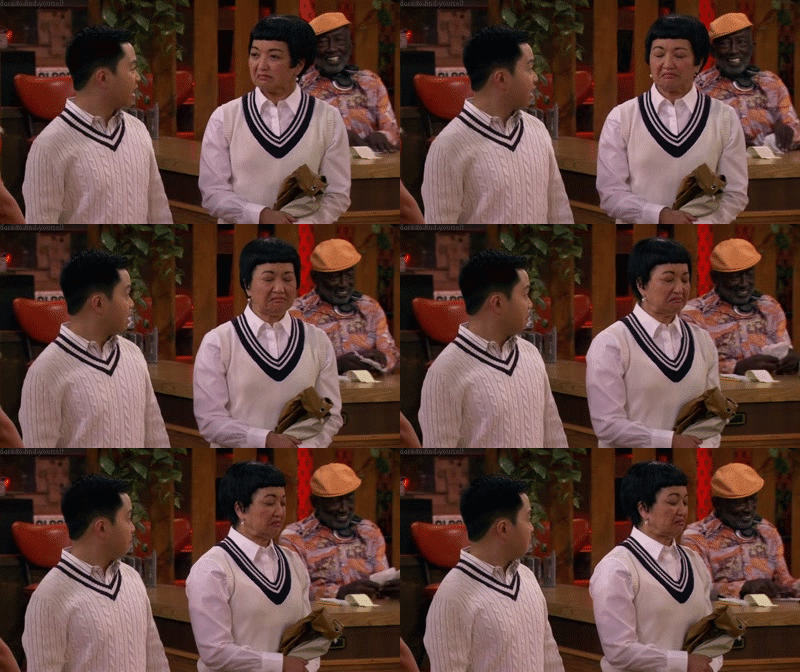
On season three episode seven of 2 Broke Girls, Han’s mother was featured in it because she came to the United States and wanted to know about Han’s girlfriend. The truth is Han doesn’t have a girlfriend but he doesn’t want to disappoint his family so he had to lie to his mom. Han thinks of himself as the star of his family, and I can see where that comes from because he is quite successful as an immigrant by having his own diner. However, since Han lied to his mother so he asked Max and Caroline for help because he needs a girl friend before his mother appears. Han found a girl on the website and that girl happens to be a prostitute but Han doesn’t know that from the website so Max and Caroline helped Han by asking the girl, Sapphire, to pretend to be his girlfriend when his mother comes.

Han’s mother, Mrs.Lee, appears to be a very traditional Asian woman and Max and Caroline recognizes her as Han’s mother when she stepped into the diner because they dress the same way. Han’s mother is seen as traditional because she doesn’t like how Max dresses so revealing so she always give Max a look when Max talk to her. Mrs. Lee thinks Han’s girlfriend is so amazing and she thinks it’s perfect match for Han because Sapphire is super Christian.
I think Mrs. Lee is a reflection of most Asian American mother who wanted their children to find someone who has same tradition and customs as them. Mrs.Lee likes Sapphire because she thinks Sapphire is super religious and obedient but she didn’t know that everything was fake. However, there is twist towards the end of the episode. When Mrs. Lee finds out about the truth she also reveals to Han that she was divorced with Han’s father.

Saturday, May 24, 2014

Are You Even Indian?

     Mindy Kaling is best known for her work as a writer and producer for the popular comedy The Office, but she also plays the funny Indian American co-worker Kelly Kapoor within the show. Introduced in episode two, she initially plays a minor role as just another static character of the office in most of season one. As part of the somewhat racially mixed cast that also includes African American sales representative “Stanley” and Latino accountant “Oscar”, Kelley usually finds herself at the end of Michael’s (Steve Carell) racial jokes throughout the season for the effect of comedy, but like the rest of the workers she puts up with the pranks and quirkiness of her manager. It is not until season three that Kelly develops a much more complex character exemplifying, although generally, an Indian American.


     Kelly’s portrayal as a product of polyculturalism in America is best featured in the season 3 episode “Diwali” where the episode starts off with her extending an invitation to the office to attend the “Indian Halloween,” but to Michael’s disbelief, she is not able to explain the deeper significance of the holiday. Michael was initially “appalled” at the office workers for not being knowledgeable enough of the Indian festival and was hoping for an excellent explanation from Kelly, but she amusingly plays it off as just being an “awesome” celebration with food and dancing. I think Michael’s disappointed response represents some of the audience member’s reactions to her very uninformed reply to his question, but I think this was the reception that Mindy Kaling wanted to create to say something about Asian American participation in Asian traditions through the genre of comedy shows. Just because someone is Asian, or even of another racial background, does not mean they understand what a festival so closely connected to the “motherland” is truly about because they grow up in America where older traditions tend to not guide the whole of their lives. Also, by using comedy, Mindy is able to get audience members to easily understand such a complex subject as identity. For Kelly, Diwali and other festivals might be special to her in defining herself to be Indian American in some small way, but it certainly does not seem to have the same amount of meaning as it does with her older generation parents who are introduced later in the episode. Even so, she willingly chooses to participate in that cultural space among her relatives and even tries to friendly invite her co-workers to have fun while in attendance. This then may bring up the question, what makes someone an Asian American? Kelly’s character continues to develop throughout the seasons of The Office by being largely contradictory of the properly behaved Indian American stereotype with her exaggeration for her love of shopping or lack of knowledge of Indian culture. Yet, she informs audiences of what it means to be polycultural because, as not stereotyped as she is portrayed in the show, it is very difficult for anyone to define the boundaries that make Kelly an Indian American or not. Kelly is certainly ethnically Indian, but the way she portrays herself as an Indian American and to what extent, is ideally up to her.


     Mindy eventually plays off her own character’s lack of knowledge by having Michael and Dwight hilariously teach the office in detail about Diwali and the “weirder” side of Indian culture in the beginning of the episode because they “don’t want to be embarrassed when they attend” the Diwali celebration. However, the important concept to take away from this episode from an Asian American point of view is that Kelly, like Raj in "The Big Bang Theory", is a product of both her Indian parents and her life in America. By participating in Diwali she still shows that she wants to try to remain connected to her Indian heritage despite often contradicting the Indian American stereotype in comedic ways. Because the episode is primarily written for comedy as well, humor also allows audience members to understand these complex concepts in an easier way.

Be sure to comment below! I would like to hear your thoughts whether in agreement or disagreement! I think it is important to discuss these even in the context of speaking about comedy shows!

Video link to the scene: http://www.spike.com/video-clips/2ud21r/the-office-dwight-explains-diwali